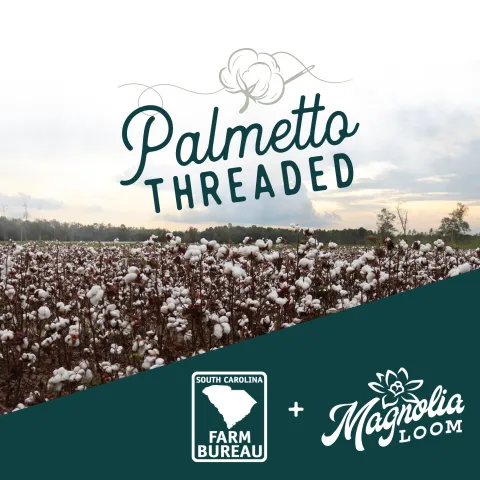
Farm to casual wear? Join farm to table as Palmetto Threaded spins a yarn that begins with seeds. It’s a story you can wear. A story that fits you to a T. A story you’ll cotton to. Why you might even drive by a field of cotton and wear some of that cotton down the road.
Neither is it a stretch to view crops as farmers’ children. Farmers bring them into the world, nurture them and send their crop-children into the big wide world. But where do they end up?
That question stayed in the mind of Bamberg County’s Mary Katherine Harrington. She wondered where Harrington Farms’ cotton went and what it became.
Mary Katherine and her husband, Madison, took the mystery out of their cotton’s fate. They grew cotton for Palmetto Threaded to make T-shirts from. Now, the Harringtons know exactly where their cotton goes and what it becomes. And so do you, but first here’s a trivia question: How many cotton plants does it take to make one t-shirt? Read on . . . the answer’s looming.
Palmetto Threaded, The Beginning
Mary Katherine Harrington’s curiosity about her cotton’s destiny led to action.
“The idea behind Palmetto Threaded,” she said, “began within South Carolina Farm Bureau’s Young Farmers and Ranchers State Committee. Madison and I served as the Coastal District representatives from 2023 to 2025. During one of our meetings, we were explaining the process of cotton production and the obstacles we face. One thing discouraging us was the fact that once our cotton went to the gin, we never knew where it ended up. While we love that we’re a part of feeding and clothing the world, we wanted a way to link the producer to the clothing of South Carolinians.”
In the fall of 2024, Palmetto Threaded purchased a bale of cotton from Harrington Farms. Over the winter, it produced T-shirts and launched its brand in February 2025 during the Young Farmers and Ranchers Conference.
“With the help of Farm Bureau,” Mary Katherine said, “we made connections with Magnolia Loom. Our bales went through extensive grade evaluations and were hand-selected for processing. Being that this was a project created by our committee, we wanted to give back to South Carolina farmers.
“Palmetto Threaded donates a portion of its proceeds to the SC Farm Bureau Land Trust to help farmers around the state protect their land against threats of development and urbanization so it, too, can be passed down for generations to come.”
Today, Palmetto Threaded contributes to South Carolina agriculture by transforming local cotton into high-quality T-shirts. The partnership between South Carolina Farm Bureau and Magnolia Loom makes sense. Farm Bureau and Magnolia Loon share similar missions and they make for a good fit.
Palmetto Threaded’s mission includes ensuring the future of agriculture in South Carolina. Toward that goal, Palmetto Threaded markets seven high-quality T-shirt designs, including shirts that feature various commodities grown in the state such as cotton, soybeans, corn, cattle, peanuts and poultry. A more recent design pays tribute to the 2025 State FFA Convention.
Think of the tees as graphic fundraisers. Just as Palmetto Threaded contributes to farmers and farming in South Carolina, Magnolia Loom also produces shirts for Georgia whose proceeds contribute a percentage to the Georgia Foundation for Agriculture.
Loren Lindler, chair of the Palmetto Threaded sub-committee, chaired Farm Bureau’s Young Farmers & Ranchers State Committee back when it conceived of Palmetto Threaded as a way to help South Carolina farmers and farmlands.
“From the first round of cotton we purchased from Harrington Farms, we produced 1,800 shirts,” said Loren. “Most cotton farmers never see where their crop ends up after it leaves the field. That’s what makes this project so meaningful. Cotton grown in Bamberg County has been spun, woven and sewn into T-shirts, connecting local farms to the clothes we wear every day. Seeing that full circle has been incredible, and it’s a reminder of just how many hands and hearts are behind every product. We’re proud to showcase South Carolina cotton in a whole new way and can’t wait to welcome more farmers into this homegrown initiative soon.”
Loren noted that South Carolina is one of the fastest-growing states in the nation, and farmland is disappearing at an alarming rate.
“As young farmers, we feel a responsibility to protect the land that feeds and clothes us. That’s why ten percent of every Palmetto Threaded T-shirt goes to the South Carolina Farm Bureau Land Trust . . . to help keep farmland in farming and ensure future generations the same opportunity to work the land we love.”
Magnolia Loom
Zeke Chapman, founder of Magnolia Loom, grew up in Sandersville, Georgia. When he was 11 years old he sold produce while raising a small herd of cattle with the help of his father. Flash forward to 2020 when he saw the need for a Georgia-grown-and-sewn garment. He founded Magnolia Loom.
“Every shirt we produce gives a portion back to the Georgia Foundation for Agriculture,” said Zeke. “To date, we’ve raised over $60,000 for the Foundation and look forward to helping raise a new generation of farmers while taking care of the ones we have.”
The Magnolia Loom T-shirt has a branch of cotton bolls on its back and the words, “Don’t Want No Poly On My Back.” Ordering information says, “The shirt says it all! Cotton is a great natural product that can be worn for years and then recycled. Polyester will be the same plastic it is today decades from now. Support agriculture, our local economy and the planet by getting one of these shirts today.”
Closing out the production cycle for Palmetto Threaded T-shirts is a natural fit for Chapman’s company. It cuts cloth, sews it, dyes it and inspects it. The company labels T-shirts by size and prepares artwork and decorates them as orders come in.
“Every one of our garments are handcrafted right here in the USA,” said Zeke. “Small businesses across Georgia and North Carolina turn seeds into shirts through a process that takes nearly a year from start to finish. Our shirts are made with the farmer, our environment and people in mind every step of the way.”
Chapman’s words resonate with Palmetto Threaded’s initiative to transform local cotton into high-quality shirts that symbolize farmers’ dedication and hard work. Plus, they help revitalize the local textile economy. This initiative showcases the beauty of South Carolina cotton while providing farmers fair compensation and a way to share their stories directly with customers.
South Carolina was once a leading producer of cotton and textiles, with mills and farms forming the backbone of its economy. The rise of synthetic fibers, poor trade deals and cheap foreign labor markets killed the industry’s competitiveness. By the late 20th century, many mills had closed. The once-thriving industry that had shaped our state’s local communities lay in ruins.
For cotton farmers, companies like Magnolia Loom help restore value to their product through non-traditional marketing outlets. And it adds to the pride with which the crop is grown to see people wearing it.
Harrington Farms
Mary Katherine Harrington grew up on a traditional, southern row-cropping operation in Bamberg. She graduated from Clemson in 2018, earning a degree in agricultural mechanization and business, as well as a minor in plant environmental science. Following graduation, she returned home to live on the family farm.
“My husband, Madison, and I established Harrington Farms in 2018 alongside my family’s operation that my father owned and operated. In 2022, my father made the decision to retire, so Madison and I stepped up to take my family’s farm to the sixth generation.”
The Harringtons grow cotton and peanuts on 1,000 acres in Bamberg County. They partner with South Carolina Farm Bureau, Clemson Extension and other agricultural organizations on various projects to improve their operations and the local farming community. They focus on efficiency and sustainability and utilize precision planting, fertilizing and irrigation methods.
“We do everything in our power to preserve the land we produce on,” said Mary Katherine. “We utilize minimal tillage practices, cover crops and irrigate when crucial to the crop’s development. We also create terraces to minimize the movement of soil and nutrients.”
They employ strict crop rotation. “We produce cotton for two years and then rotate in peanuts to combat nematode and disease pressure with the least amount of fungicide and nematicide possible. We want to ensure that this operation stays in business, so it can one day be passed down to our two young sons. You can’t farm without land, so we want to leave that land in better shape than when we started with it.”
From start to finish, these shirts support hard-working Americans while preserving a lifestyle we love. It’s amazing to see this come together. — Mary Katherine Harrington, Cotton Farmer & SCFB Member
Thanks to the Harringtons, South Carolina Farm Bureau and Magnolia Loom, Palmetto Threaded celebrates South Carolina’s rich agricultural heritage by offering high-quality T-shirts crafted from South Carolina-grown cotton. Seed to shirt supports local farmers, preserves regional craftsmanship and provides apparel for those who value authenticity, sustainability and the strength of community.
It’s often said that cotton is the fabric of life. The next time you pass a snow-white cotton field, imagine a field of shirts, towels and jeans. Behind every cotton shirt, towel and pair of jeans, you’ll find a farmer who planted the seeds that made it possible. Cotton is a staple of life. South Carolina farmers do a lot more than put fiber in your diet; they put fiber on you that fits to a T - T-shirt, that is.